
A Closer Look at an Alternative Rock Fashion Icon
“Hey kids, this is a female rock star. Take some notes.”
“Hey kids, now that’s a rock star. Take notes.”
“PJ will always be so damn cool.”
“PJ will always be f*cking cool.”
“She doesn't sound like anyone else. She's completely unique. She's perfection.”
“It’s unlike anything else. It’s completely original. It’s perfect.”
“I feel like I'm watching a nightclub act in a David Lynch movie.”
Comment posted on YouTube under the video clip for "Down by the Water", a song by PJ Harvey released in 1995, posted in 2010 on the artist’s channel.
Even today, the comments under the YouTube videos on PJ Harvey’s official channel remind us that this rock icon is an icon for people of all generations.
Polly Jean, a young Englishwoman from a region straight out of a Victorian-era Gothic novel (Dorset), became a rising star of rock at the age of twenty-two when she formed the trio PJ Harvey (because, yes, before PJ Harvey was just her, there were Rob Ellis and Steve Vaughan) in 1991. Much like the “girly pop” artists of recent seasons, PJ is the epitome of “girly rock” —experimental, a classy wild child, and a secret icon. No biography of the artist has ever been written; she is surrounded by watchdogs (her managers) who protect her when she escapes to her native countryside. PJ has always left few real traces of herself, outside of her art.
However, in 2019, filmmaker Seamus Murphy featured the artist in a documentary titled *A Dog Called Money*:
A journey alongside PJ Harvey, following the creative process behind her new album,*TheHope Six Demolition Project*, inspired by her travels around the globe—to Afghanistan, Kosovo, and the poor neighborhoods of Washington, D.C.
PJ also embodies a bold assertion of feminine identity. Whether she considers herself a feminist or not, one image stands out: the hair under her armpits, as photographed by Kevin Cummins in the 1990s, becomes an ornament—perhaps a piece of jewelry—or an article of clothing. Female body hair becomes not only natural but practically sensual, transforming into a desirable part of the body, just like any other part of a woman.
But what set PJ apart in her day when it came to her image was her chameleon-like nature—her ability to change her style over the years. Recognized by all as a rock fashion icon, everyone agrees on one thing: reinventing herself has never been a challenge for the artist. But this ability to reinvent herself has suddenly taken on a new dimension in an era where “clean girl,” “Y2K,” the “rock girlfriend aesthetic,” the “mobwife aesthetic,” and so many other completely fleeting trends have taken over the internet and social media. The paradox: multiple styles, multiple directions—and yet, according to the rules of social media, it’s very difficult to switch from one to the other. When you’ve built your image around a certain visual style, a radical change can quickly lose its appeal or come across as a costume that the public will soon forget. Hailey Bieber remains the ultimate “clean girl”; Kylie Jenner, once the face of the “KingKylie” full-face look, has softened her image, though it took her some time to make the transition. Rebranding—a term that’s been very popular for several years—can be a lifesaver, transforming a public figure who’s the butt of jokes into a credible figure. But as risky as rebranding may be, it can also overwhelm us with the various visual aesthetics on Instagram, TikTok, or Pinterest.
Looking back at PJ and its ability to reinvent itself since the 1990s might help us take a step back and get a breath of fresh air from a bygone era.

1991: PJ Harvey (The Girl and the Band)
In the early 1990s, the trio released two albums, *Dry* and *Rid of Me*. At the time, Polly Jean was only between twenty-two and twenty-four years old. She was already a rock star, since her career hadn’t really taken off with the band—she had already started out at a younger age. But above all, Polly didn’t wait for success to reveal her unique charisma.
What defines this era: a face free of makeup, the natural contrast of her features, opal-toned English skin, a cascade of raven-black hair, thick eyebrows, and deep, round eyes. PJ’s style in the early nineties was her most natural self.

Here, she’s wearing just one earring—a silver hoop, one imagines, a bit chunky. She plays with asymmetry by wearing simple clothes with significant details. Around her neck, a chain holds what looks like a small figure, if not a baby. It’s offbeat, almost subversive—but only almost. Not quite bold enough to be shocking. Just enough quirkiness to raise an eyebrow in confusion. Here, already, in a single image, PJ establishes herself as a woman whose details are hard not to scrutinize. The irony of the photograph: she is its main subject, holding up a mirror toward the camera—and indirectly, toward us. “You’re staring at me, but I can see you,” she seems to be telling us.
Why bother with clothes when you have body hair? Polly Jean redefines femininity: bushy eyebrows, a thick mane of hair framing her delicate features, and hairy armpits. You can see her baby necklace in the photo for “Rid of Me,” and her single earring in the photo by Kevin Cummins.

Before tackling the issue of clothing, the essence of PJ’s fashion lies in her own body, her own physicality, and her redefined femininity—at a time when grunge and post-punk had paved the way for rebellion, particularly in England.
1995: Blood Red and Baby Blue
Now pursuing a solo career, it was during this period that she released her album *To Bring You My Love* (1995). On the album cover and in the accompanying music videos, she sported a makeup look that would become the most iconic of her career.
Baby blue eyeshadow, dark eyebrows, XXL false eyelashes, and scarlet red lips. All set against her ivory-toned complexion. What defined her during this period was her musical experimentation, which, in the context of her life, went hand in hand with her experimentation with her image.
Wonder Woman!

In her 1995 interview with I-D magazine, she reflects on an event in her life that shaped the young woman’s self-perception at the time: after several bouts of depression, now twenty-five years old, she felt for the first time the liberation that comes from shifting the focus away from the world and toward herself. Emerging from her gloom taught her one thing—or perhaps that very realization was what pulled her out of her gloom in the first place: not everything had always been about her.
Do these colors symbolize a new era—one that goes beyond the artistic and is deeply tied to the young woman’s sense of identity at that time?
On the cover of I-D, she wears a bra in the colors of the American flag that matches her makeup. International success has a festive feel to it. It’s the perfect opportunity to wear a blue sequined dress on stage.
Like many rock icons, Polly’s wardrobe isn’t cataloged. It’s up to us to scour the thrift stores for that hidden gem.


"To Bring You My Love" was also a time of pink, bright colors, and experimentation with materials—including faux leather—and very form-fitting cuts. PJ Harvey explores styles that no one else really goes for. She’s the only one who looks like herself—the only one to choose a pink jumpsuit that’s open right down to her cleavage, paired with a pair of youthful blue heels. All of this is complemented by the same red, white, and blue makeup.
Henry Lee: PJ and Nick Cave's "enfant terrible"
1996, *Murder Ballads*, Nick Cave and The Bad Seeds.
At that point, Cave didn't yet know that by asking PJ to come and perform one of the album's tracks with him, they would fall in love. The song—for Cave's and PJ's respective parts—was recorded neither in the same studios nor in the same countries.
It was the filming of the music video, directed by Rocky Schenck, that forced the two to look into each other’s eyes until they became lovers. In a way, if you decide to watch the “Henry Lee” music video , you’re watching them fall in love IRL. It’s very romantic, especially when you consider that the song is inspired by 18th-century murder ballads —literally, ballads about murder. These morbid-sounding songs recounted stories of sordid murders. It’s a sort of tradition that has been preserved, revived, and never abandoned by folk and country music. The song “Henry Lee” draws on preexisting sources of inspiration, such as “Young Hunting,” a murder ballad in which a man who tells his pregnant wife that he’s in love with another woman is stabbed to death by her.
Romanticism, they said. But above all, rock.
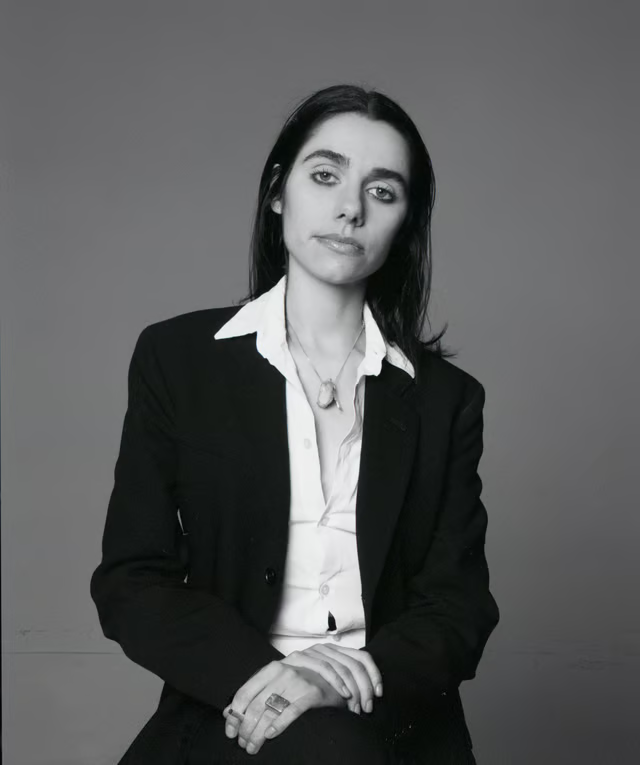
In the music video, the soon-to-be lovers decide to wear matching outfits. So we see PJ in a suit and white shirt. At first glance, there’s nothing left of the Polly we once knew.

This isn’t the first time the artist has worn a suit. Last year, for the music video for “This Is Love” from her album *To Bring You My Love*, she wore a white bell-bottom suit as she played guitar and sang the lyrics of her song, which flowed from her red lips. Polly Jean knows a thing or two about suits. This time, it’s all about unity and simplicity. The tragic fate of the lovers in “Henry Lee”—beyond being linked by Nick Cave and PJ Harvey—is bound by identity. The two lovers blend into one another in the video. We see a male alter ego and a female one. They are each other’s doubles. Without realizing it, PJ is foreshadowing what would become one of her most famous love stories. She herself probably had no idea.
The suit she’s wearing is a sign of both restraint and wisdom. We’ve said that nothing remains of the Polly we once knew—but that’s not true; her fuchsia-pink nails and her necklace with the chunky pendant are still there. Historically, PJ Harvey’s suits have been an affirmation of both her femininity and her status as an icon of alternative rock. When PJ turns to colors other than pink or blue, or to various textured fabrics, it’s always to put on a suit. Playing guitar in a suit and heels carries a sense of revenge; singing alongside Nick Cave in the same outfit reaffirms her status as his equal as a woman. The video exudes love and romance, but PJ is no less than Cave.
Karmic Connection: Ann Demeulemesster
In 1991, she used her body and the babies around her neck to express her femininity.
In 1995, there were false eyelashes, faux leather miniskirts, fuchsia pink, and suits with heels—all ways of expressing one’s desire for another.
In 1996, he wore simple outfits to express his love.
In 2001, on stage, there were miniskirts and black bras—a return to the roots.
But from 1995 to the present, a designer has been a constant presence in the artist’s life. Whenever PJ needed a shield, she always turned to her.
In 1995, Ann Demeulemesster gave PJ Harvey a leather jacket—like a chain mail shirt—to wear in times of distress.
Ann Demeulemesster is all about boho-chic—black, white, and metal. Her silhouettes evoke conquering ravens. It’s the clash of materials—leather and silk (revived during the brand’s Fall/Winter 2024–2025 runway show, under the artistic direction of Stefano Gallici, who paid homage to the brand’s DNA). It’s a dark and poetic femininity. It’s a lead bullet wrapped in tissue paper. It’s the very definition of PJ Harvey.
There are just as many Demeulemesster designs in PJ’s wardrobe as there are PJ songs playing in Demeulemesster’s headphones.
The two women made a pact of mutual recognition more than thirty years ago.
It's enough just to watch—no need to explain.


