In 1994, Robert Altman’s*Prêt-à-porter* depicted the world of fashion through the lens of Paris Fashion Week. Nominated for two Golden Globes, the film is a satirical drama that both glorifies and mocks the fashion industry. It is a vision of a “total” fashion film, which, in practical terms, requires bringing together several elements.
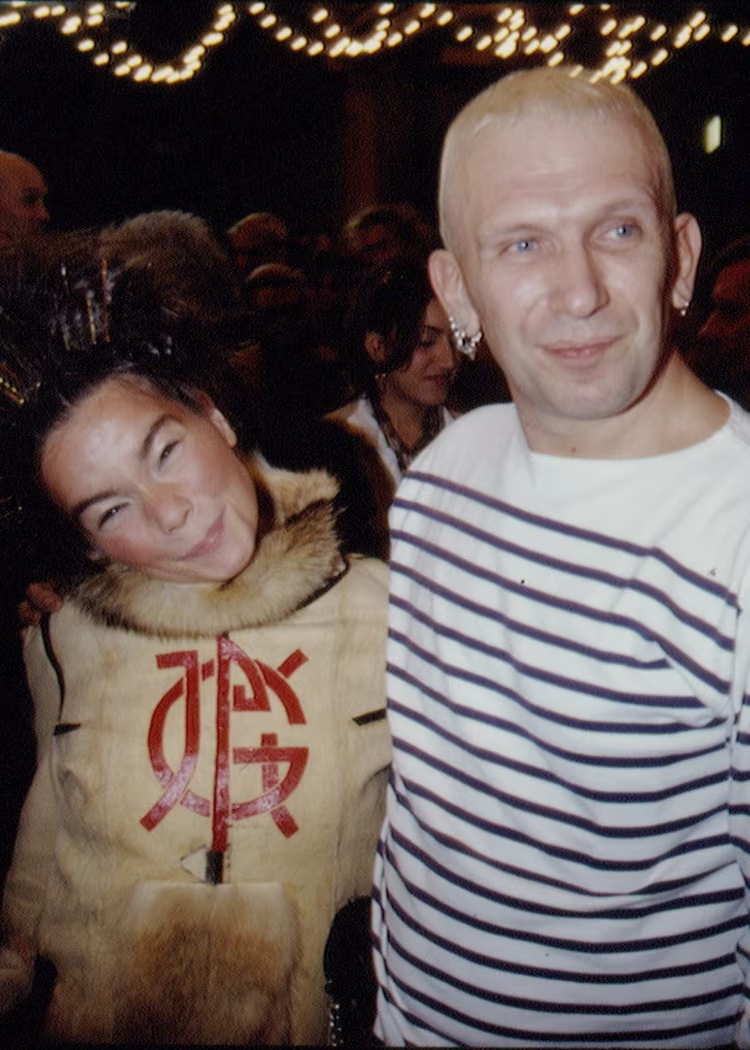
Björk with Jean Paul Gaultier at his Fall/Winter 1994–1995 fashion show in Paris, filmed and featured by Robert Altman in his movie *Prêt-À-Porter*.
What sets Robert Altman’s work in this film apart is his ability to have us follow several characters without knowing whether their paths will cross—and if they do, what significance that will have. In *Nashville* ( 1975), he employed the same structure, featuring some 24 main characters. Here, the story unfolds in the same way: from the murder of Olivier de La Fontaine (Jean-Pierre Cassel)—which causes a media frenzy in the midst of Fashion Week—to reporter Kitty Potter (Kim Basinger) digging into all the big and small news stories of the season. Meanwhile, La Fontaine’s wife, Isabella (Sophia Loren), prefers to reunite with her lover Sergio (Marcello Mastroianni), who, incidentally, witnessed her husband’s death while they were riding in a taxi together. The cause of death will be announced by detectives Forget and Tantpis (played by Michel Blanc and Jean Rochefort, respectively) and revealed to be suffocation by a piece of bacon. This won’t stop the police from considering the murder theory throughout the film. Anyway. We move on to Julia Roberts as reporter Anne Eisenhower, arriving at the Grand Hôtel de Paris, where her room is already occupied by Joe Flynn (Tim Robbins), a sports reporter stuck in Paris to cover the famous murder. Altman’s choice: to lock these two characters in the same room, with lust running rampant, amid the obvious luxury of one of Paris’s most beautiful hotels—champagne and bathrobes—causing poor Anne to relapse into her alcoholism and dragging Joe along with her as he cheats on his wife. The result? No scoop to report on for the week for either reporter. Everyone has their own dramas, since the fashion designer Simone Lowenthal, played by Anouk Aimée—who is, incidentally, Olivier La Fontaine’s lover—learns that her son has sold her fashion house to wealthy Texan boot merchants. And for good reason: Lowenthal’s final fashion show will feature naked women on the runway. Women do take their revenge. Meanwhile, Cort Romney (Richard E. Grant), working for Christian LaCroix, cheats on his wife Violetta with designer Cy Bianco (Forest Whitaker)—unaware that Violetta herself is cheating on him with Cy Bianco’s assistant. Apparently, love triangles exist here too.
Having trouble keeping up?
That’s to be expected: between the intertwining storylines and those that have absolutely nothing to do with one another, Altman presents a screenplay co-written with Barbara Shulgasser that captures the atmosphere of Paris Fashion Week.
To tell the truth, it’s hard to make sense of it all; we don’t know which way to turn, but everything is in a frenzy, like an overfilled pot that boils over when the pasta is done. Everything hangs by a thread, and our frontal lobe is taking a beating. Fashion is a constantly evolving world; hysteria reigns, but creativity takes the upper hand. If fashion exists, it’s first and foremost a matter of identity—a matter of what we want to show the world. Someone who doesn’t dress “fashionably” is wrong to think they aren’t part of any school of thought. They belong to a community of people who believe they can claim to be uninterested in modern dress codes—which, incidentally, are a direct reflection of the era and contemporary society—and thus feel completely detached from the system. The problem with this maneuver—like a missed turn—is that it already says a lot about their confidence and their stance toward the world. In short, fashion is a serious matter.
But to what extent? Is it really worth getting worked up over a pair of broken heels, no matter how expensive they are?
In the nude fashion show scene, the question being raised is clear: it’s about asking whether fashion is really that essential to human beings. The naked body is the body in its natural state; putting clothes on it makes it social, and putting on expensive, haute couture clothes—designed with unique shapes and materials—distances it even further from its source, its essence, its identity… or perhaps not, if we consider fashion as a means of self-expression. Ultimately, the answer is unclear, a bit ambiguous, and mixed. Fashion is beautiful; fashion radiates laughter, tears, and hysteria—it’s beautiful and sublime. But shouldn’t we still take away at least a little of its credit to ease the fact that we didn’t manage to snag that Balenciaga Bel Air bag, which would have cost us five months’ worth of the minimum wage anyway? Isabelle Huppert is the brand’s muse, but we have to admit, we don’t have her budget. This film portrays fashion with both tender affection and a certain degree of criticism. To be honest, *Prêt-A-Porter* feels like a gentle satire, like that hysterical, hyperactive friend who cries constantly over heartbreak, but whom we still love—she also comforts us in difficult times.
Much like an exhibition,
Just as if we were visiting the Dior or Alaia Foundation in Paris, the camera turns us into spectators—but more than that, into observers. The camera movements follow the characters; in several scenes, we watch their actions reflected in mirrors—to tell the truth, we’re voyeurs. But don’t worry—we’re quickly excused for our vice; the characters themselves are there to watch one another. The camera moves from right to left, then from left to right, and we’re treated to a drama filled with high society intrigue, interwoven with mundane vulgarities and fascination. We often zoom out or in on different situations. One scene that stood out to us: Isabella’s dog show at the beginning of the film. The camera films the podium, then zooms out to reveal the scene to us. People sitting on the lawn, dogs with fancy hairstyles being watched without their knowledge, little ribbed collars to prove that if you’re a dog, at least you’ve got style. Poor creature.
The comedy of the staging also draws us in. When the editors of *Elle* and *Vogue* are assigned their respective hotel suites, they realize that their suites have been switched. And this simple twist—just enough to make us chuckle—works. There’s no need to create a contrived scene full of subtext when showing the least actually reveals the most. The two women, whose suites are, in fact, right next to each other, are up in arms about not having the right one! And for good reason: a single shot, framed by two sets of stairs, two doors side by side, and identical assistants with identical facial expressions. The scene is as sparse (in a good way) as the characters’ intellectual depth. The same suite, sure; the door next door, sure; with the same decor, sure—but my God, this isn’t the suite with my name on it!
The shots are rarely static; there’s camera movement, changes in focal length—everything to let us catch a glimpse at the right moment, in the right place. The film mirrors the industry itself: bustling, in motion, voyeuristic. The notion of reflection—mentioned earlier in connection with mirrors—also serves as a reminder of the doubts we’re free to harbor about the characters and their intentions. Once again, a simple message, simple staging.
Name-dropping in the movie, or the art of delighting our ears:
What makes this film a true fashion spectacle is also the cast—a star-studded cast, the crème de la crème of high society; in fact, everyone is there. While Julia Roberts gets drunk at the Grand Hotel, Sophia Loren joins her lover, Marcelo Mastroianni, following the death of her husband, Jean-Pierre Cassel. Anouk Aimée is preparing a fashion show for the world’s biggest fashion week, while Kim Basinger is doing feature stories that are 30% successful—but, like *Closer*, they sell. Michel Blanc and Jean Rochefort are leading the investigation. A Franco-Italian-American cast, paying tribute to the big names in fashion. But aside from the actors (whose list we’ve greatly shortened—otherwise we would have mentioned François Cluzet as the assistant to Nina Scant (Tracey Ullman), an editor at Vogue), there are, of course, the designers on one hand and the models on the other. First up: Thierry Mugler, fielding Katty Potter’s outrageous questions. Later, we see Jean Paul Gaultier, suffering the same fate. The list includes Christian Lacroix, Sonia Rykiel, Gianfranco Ferré for Dior, Issey Miyake, and our beloved models Linda Evangelista, Naomi Campbell, Christy Turlington, Carla Bruni, and Claudia Schiffer. In addition, Björk walks the runway for Jean Paul Gaultier, Cher is interviewed by Katty Potter, Rossy de Palma appears as Lowenthal’s assistant, and finally, Harry Belafonte—also interviewed by Potter (we warned you, she’s everywhere)—is upstaged by Isabella de La Fontaine, who faints after seeing the face of her handsome lover, Sergio, once again. That’s not just a few, but a lot of faces for a single two-hour film.
What’s fascinating is everything we missed, but which is clearly listed in the credits: the brands that contributed to the film. For costumes, there’s Prada, Doc Martens, Céline, Adidas, Levi’s, and Lacoste, for example, and for props, Bottega Veneta, Gucci, and Louis Vuitton—and, just like in fashion, there’s photography, with Leica and Polaroid.
Special thanks to the designers: Azzedine Alaia, Giorgio Armani, Chanel, Comme des Garçons, Yves Saint Laurent, Hermès, Nina Ricci, Kenzo, and Paco Rabanne (to name just a few). To find the models, we had to turn to the most prestigious agencies, such as Elite Models and Ford Models.
Whether in its concept, direction, casting, cameos, or brand references, *Prêt-à-Porter* is a complete tribute to fashion—a critique and an exploration. It offers plenty to think about and enjoy. Altman even manages to gently poke fun at *Vogue*, *Harper’s Bazaar*, and *Elle*—the industry’s most prestigious magazines—by setting a trap for each of the editors. We’ll leave it to you to discover which one, and the solution devised by the three women… which is as satirical as ever.
After a soundtrack by Michel Legrand, the film ends with “La Vie en Rose” performed by Grace Jones. A charming, French, lighthearted note to close the film. Long live Paris!