Is it possible to remember on someone else’s behalf? Can another person’s memory seem so familiar to us that it almost clouds our logical judgment? To what extent is memory a tangible aspect of the mind?
In the Salon d’Honneur of the Grand Palais in Paris, plunged into darkness, we step into a shadowy cocoon. Here, people form lines, and then—after one line, then two, then three—we begin to make out what lies at the end: five rooms created within the Salon d’
, like sealed islands of velvet. And so, in this exhibition dedicated to the work of Nan Goldin, we find the metaphor of memory. We wander through a vast black brain. A collective matrix granting us access to a different memory as we move in and out from one island to the next.
Nan Goldin’s body of work spans nearly sixty years of intimate photography, capturing everything it has to offer—from the most defining aspects of identity to its darkest sides: addiction to sex and drugs. Sexual and gender identity, passionate and/or destructive love. In this exhibition, running from March 18 to June 21, 2026, the Grand Palais invites us to explore five of the artist’s slideshows, along with a sensory projection designed to make us experience the equivalent of an LSD trip.
From one slideshow to the next, images recur; the themes diverge, yet echo one another. In this vast collective memory, from one memory to the next, the train of thought continues.
What does this exhibition invite us to reflect on?

A Look Back at the Artist
In 1953, in Washington, D.C., a little girl was born who would turn the lens of her camera into a tool for documentation—more than just photography, if not cinematography.
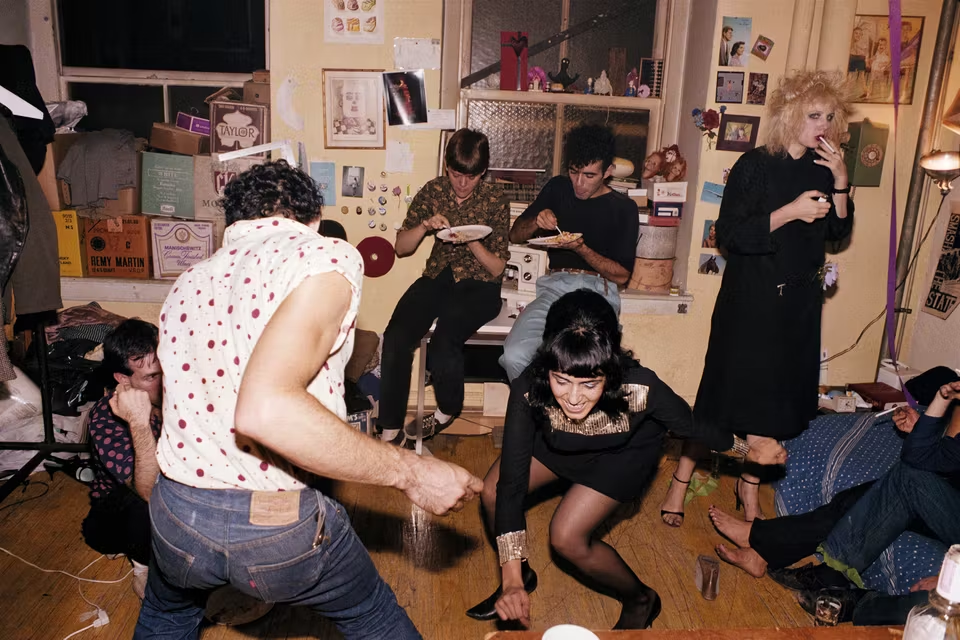
Nan Goldin traverses eras and cities: drugs in the 1980s, trans identity in New York, love throughout the ages. She uses her photos and videos in various slideshows that she has put together over the years, weaving them into stories organized around specific themes.
A common thread runs through each slideshow: the exploration of her own intimacy and that of those around her. It’s quite unsettling to watch a Goldin slideshow, so overwhelming is the sense of voyeurism. Those naked bodies in the shower, with their body hair. Those bedrooms belonging to others that we’ve entered not through the front door, but through the lens of a camera. There’s no obvious staging. Just bodies and faces that seem familiar to us—
—as we watch, over and over, the same people reappear on film. Bars like the thousands that exist, and yet, deep down, that sense of familiarity endures.
Nan Goldin talks about sex, drugs, love, disappointment, euphoric joy, and death. But above all, she speaks to us about that thing that binds every human being together—that reality that makes death possible, that makes pain a necessary experience and joy a reward: life.
She decided to take up photography shortly after her sister’s suicide in 1965. She was twelve years old at the time. In an interview with MOCA (Museum of Contemporary Art) in 2013, Goldin explained two things: what drove her sister to take her own life stemmed from the fact that she “wasn’t born in the right era—
—and that she was never able to find other people like her.” The second point is the general taboo that surrounded her sister’s death. Her family preferred to keep the subject quiet. It is then that the photographer’s entire body of work takes on its meaning: she begins to photograph her era and its excesses, as if to legitimize the temporality of her photos and her life, and above all to prove the existence of things. While her deceased sister is a subject of silence at home, the rest of the world must be loud for the artist. The aim is to show that we have lived through what we have lived through—that people, tragedies, joys, problems, and colors exist—since everything has been captured on photographic film.
From an artistic standpoint, what matters is not the technical quality of an image, but its content. As she herself says, she has a very saturated view of life. Technically speaking, color is the only thing that really matters in the composition of one of her
images. “I wasn’t really interested in good photography. I was interested in pure honesty.”
She has had difficulty gaining recognition from certain photographers and gallery owners—mostly men—a point she has mentioned in several of her interviews.
Among his causes was a fierce battle against the Sackler family, American billionaires who founded and ran the pharmaceutical company that marketed OxyContin (Purdue Pharma), now known as a devastating drug, with an estimated 300,000 deaths between 1996 (when it was first marketed) and 2021 (a date based on a National Geographic article detailing the history and harm caused by OxyContin).
Since the Sacklers are one of the art world’s most prominent patron families, their financial involvement in the art world is facing increasing criticism.
Goldin herself had to contend with the addiction caused by this medication following an accident. She survived, but has been battling it for years (and continues to do so today). It was in the midst of this struggle—
—that she sought out a director to bring her story to the screen, leading to the creation of the film *All the Beauty and the Bloodshed*, directed by Laura Poitras and released in 2022. The documentary traces Nan Goldin’s body of work and her battle against the Sackler family (available for free on Arte).
To conclude our discussion of the artist, we can quote her on the subject of her work:
“There is a misconception that my work is about marginalized people. And we were never marginalized because we were the world.”
“There’s a misunderstanding that my work is about marginalized people. But we weren’t marginalized—we were the world.”

THIS WON'T END WELL
So what, then, makes up the exhibition at the Grand Palais, curated by the Franco-Lebanese architect Hala Wardé?
As mentioned earlier, each of the slideshows featured in the exhibition invites us to reflect on the themes of addiction—in the broadest sense of the term—including drug addiction, love addiction, and emotional dependence. But it also invites us to reflect on the theme of metamorphosis.
In *Stendhal Syndrome* (2024), Goldin draws on excerpts taken directly from Ovid’s *Metamorphoses*. She revisits six myths, including those of Narcissus, Diana, Orpheus and Eurydice, Cupid and Psyche… We are given no warning; we are simply plunged into the darkness of this velvet-clad space, waiting for the screening to begin. Suddenly, fragments of paintings and photos taken at the Louvre appear. A voice—Goldin’s. She speaks for the first time, and in a calm, observant tone, with the monotony of a fairy tale, describes those around her. Each myth she evokes will echo a friend, a female friend, a couple of friends, or her own relationship.
There are nude photos, but what strikes one most is not the intrusion into the physical intimacy of strangers. It is the intrusion into their love lives. The themes of romantic relationships, dependence on another, the idealization of the other, and the authenticity of emotion are all subjects found in *Stendhal Syndrome*. While the connection to the experience described by Stendhal himself—that of being overwhelmed and physically tormented by the emotional turmoil caused by a work of art—may not seem obvious at the beginning of the film, it becomes clear by the end. Just as Stendhal fainted before the Basilica of Santa Croce in Florence, love is captivated by beauty, only to collapse in the face of the harsh reality of disillusionment and emotional dependence.
*Memory Lost* (2019–2021) employs a more sophisticated technical approach. Although it remains a slideshow, the montage incorporates videos, telephone clips from the 1980s, and a male voice-over, in addition to the artist’s own voice. Here, drug addiction becomes a shared experience. After a while, the video projector displays a photograph of a mattress with one corner burned. The mattress fabric resembles scorched flesh—one imagines heroin or crack. The springs protrude like bones seared alive. A mattress without sheets, a body without clothes, burnt fabric, rotting flesh. A little earlier, a woman’s voice explains that when her boyfriend locked her in her apartment, taking all her money and confiscating all her phones to prevent her from getting drugs, she says in a voice that has grown calm and serene over the years, “It’s like being buried alive.” Some photographs appear in multiple slideshows. There is, therefore, a continuity of thought. Different subjects, same reflection.

The centerpiece of the exhibition—or at least the piece that draws the most curious visitors—is his iconic *The Ballad of Sexual Dependency* (1981–2022). Goldin first developed this work over several years (it was initially released in 1985), and it would become her best-known work—
—as well as the one that truly brought her to the attention of the general public. She continued to add to it until 2022. The essence of the work lies in the difficulty within romantic relationships of striking a balance between dependence and autonomy. It explores the dependence one might feel toward someone who isn’t right for us, particularly when that dependence stems from sex. It is a work about the sexual connection between individuals and their emotional destruction. The subject matter unfolds over a 48-minute screening, featuring a sequence of photos of couples, bodies, and dead-end relationships between men and women. The work offers an exploration of the differences between male and female language, as Nan Goldin goes so far as to document her relationship with Brian, an ex-Marine aspiring to become an actor.
, we witness their moments of intimacy and nudity, but also of violence, as in the photograph titled *Nan, one month after being battered*, which shows the artist’s bruised face one month after being beaten by her partner.
Visitors will have the opportunity to explore more of the exhibition curated by Hala Warde and the work of Nan Goldin, as the Grand Palais is showcasing it in its Salon d’Honneur through June 21, 2026.
What concludes this exhibition is also what concludes Goldin’s entire body of work, which makes it a very comprehensive exhibition (note that it is advisable to set aside an entire afternoon to see the entire exhibition). Looking back at the exhibition as a whole, two elements emerge as opposing forces in a perpetual philosophical struggle: death versus survival. What has left the deepest mark on Goldin—now seventy-two years old—in her own work is the number of people she has lost: those who succumbed to addiction, those swept away by the wave of AIDS in the 1980s in the United States, and those who fell to depression. And yet, Nan is still here, alive, a survivor, the sole chronicler of her life, her circle of friends, and a turbulent era—all while never neglecting the photographs of parties, so as not to forget that moments of euphoria and joy have always existed.