Fashion and cinema have always influenced each other. From cinematic references on the runways to fashion designers credited in major films, and more recently, major fashion houses like Yves Saint Laurent venturing into film production. There’s plenty to explore to enrich our cinematic culture through the lens of fashion. Here’s a selection of nine must-see films and documentaries—and they’re not to be missed.

Ready-to-wear
You’ll find it on every list of must-see fashion films. And for good reason—it has it all. Robert Altman has a knack for weaving together parallel storylines, some of which intersect, others that never do (as in *Nashville*, which he released in 1975), and *Prêt-à-porter* is the perfect example of this.
Paris, in the midst of Fashion Week. When Olivier de La Fontaine (Jean-Pierre Cassel), head of the ready-to-wear fashion union, suddenly dies in his taxi, the French police launch an investigation (Michel Blanc as Inspector Forget and Jean Rochefort as Inspector Tantpis). But far from being a typical crime thriller, Olivier de La Fontaine’s wife, Isabella de La Fontaine (Sophia Loren)—delighted by her husband’s death—returns to the arms of her lover, Sergei (Marcello Mastroianni). Meanwhile, the fashion designer Simone Lowenthal (Anouk Aimée), La Fontaine’s mistress, watches as her son sells her fashion house to wealthy Texan boot merchants. At the Grand Hôtel de Paris, reporter Anne Eisenhower (Julia Roberts) finds herself stuck in the same room as sports reporter Joe Flynn (Tim Robbins), and sees her alcoholism skyrocket—and… neither of them will follow Fashion Week or the investigation into de La Fontaine’s death, which Flynn has been assigned to cover. The room, the champagne, and the sex are far too important to worry about a few designer scarves and a dead body on the Champs-Élysées. As you can see, without even getting into a third of the movie, we’d love to start all over again.
And why is this movie on every list? Altman’s striking use of irony to depict the upper echelons of the fashion world—the love triangles and quadrangles, the pillow fights over the best news and the biggest scoop—and to explore the true nature of fashion and what emerges from it. For fashion enthusiasts, watching *Prêt-à-Porter* is a bit like going to that all-you-can-eat Chinese buffet down the street that we love so much and that fills us up every two weeks. You’ll see familiar faces: Naomi Campbell, Claudia Schiffer; you’ll spot designers playing themselves—Jean Paul Gaultier, Thierry Mugler—and if you’re patient enough to stick around for the credits, you’ll be treated to a feast of brands: in the accessories section, Vivienne Westwood, Prada, Levi’s, Adidas, Lacoste, Céline, and dozens more. And the list of designers involved—from costume design to on-screen appearances—is quite long. This film is an encyclopedia in and of itself.
Paris Is Burning
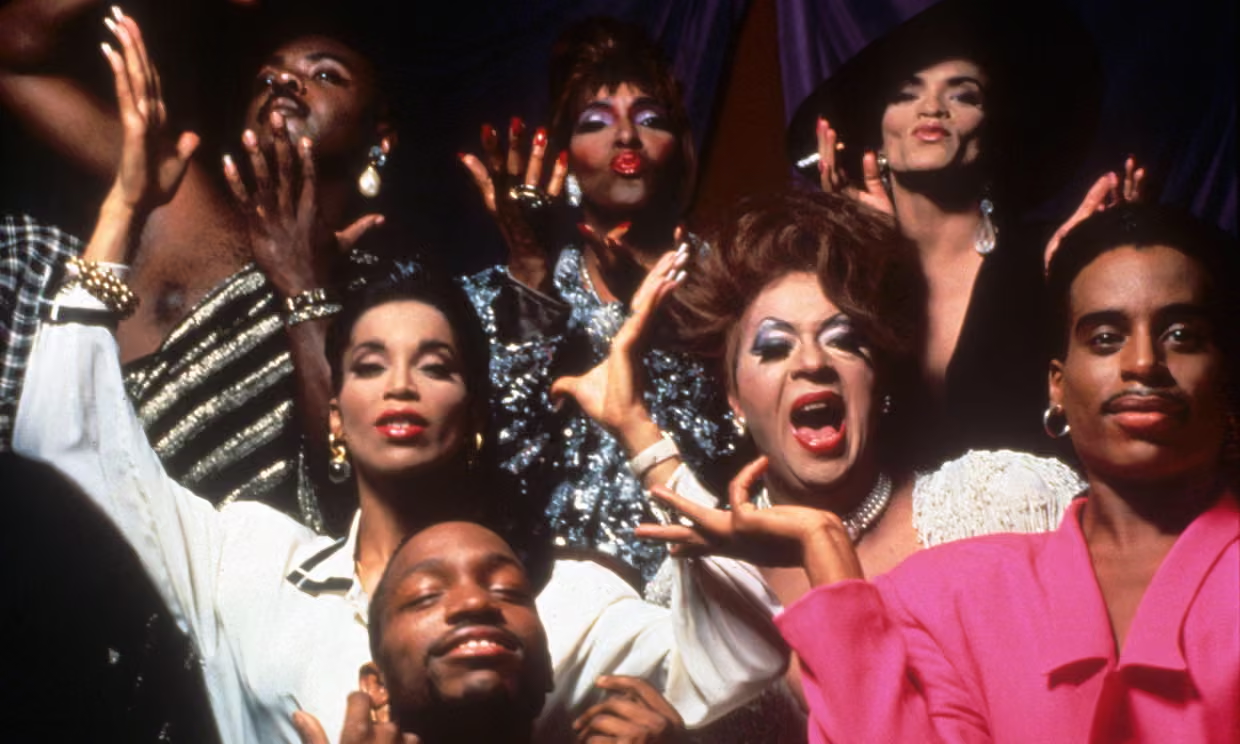
Fashion isn’t limited to just one scene. It evolves, finds its way, finds its voice, and proclaims it in the underground queer clubs of 1990s New York. One of the most iconic names associated with fashion: Vogue, Madonna. Her inspiration? Voguing. Its birthplace: the African American queer scene.
Fashion emerges as a central element in communities’ expression of identity. *Paris Is Burning*, a 1991 documentary directed by Jennie Livingston, delves into the issues facing groups and individuals during that era—an era marked by a lack of representation that gave rise to an underground scene immensely rich in fabrics, colors, and silhouettes, serving as a powerful affirmation of existence and a declaration of identity.
While the documentary addresses much more than just fashion, the subject is certainly part of it. It’s an excellent way to let yourself be swept up in the discovery of and encounters with extravagant personalities—but above all, personalities brimming with meaning—all while suggesting that the texture of a fabric can echo the texture of one’s self. How the way we present our own silhouette reflects our presence in the world.
This must-see documentary from the world of queer cinema is available in France on Mubi.

Notebook on Cities and Clothes
In 1989, Wim Wenders was asked by the Centre Pompidou in Paris to direct a film about fashion. The director was deeply troubled by the request: the world of fashion and clothing seemed so superfluous to him that he would have been better off staying away from fashion houses and runway shows.
But only one name comes to mind. Only one designer truly captured his attention. One day, as Wenders was putting on one of his jackets, he was overcome with emotion: there was something about the cut, the material—perhaps the color—that made the director feel certain that, in that jacket, he was truly himself. So the choice was made: he would follow the designer Yohji Yamamoto and answer the following question: what connection can be drawn between cinema, fashion, cities, and identity? The director draws a parallel between the work of screenwriting, storyboarding, directing techniques, and the production of an audiovisual work, and the process of creating fashion garments undertaken by Yamamoto. All of this is framed within a contextual, almost existential question, in a world where technology is advancing, gaining ground, and becoming digitized. We are a little over twenty years away from cameras becoming fully digital at the expense of film (2011), and yet, Wim Wenders is already asking these questions.
A parallel is drawn between the emerging connection between Wim Wenders and Yohji Yamamoto and the connection between cinema and fashion. What connection to identity can be explored from one city to another? What is the relationship between filmmaking and fashion design? What technological context governs our production methods? These are several questions, all interconnected, and while Wenders does not claim to answer them all, he has the humility to pose them to himself and to his audience.

Saint-Laurent, 2014
This film takes us on a long journey that explores various facets of the great Yves Saint Laurent. We see him as an artist and a designer, and we learn his story through an ingenious system of chronological organization and flashbacks to key events. But above all, we get to know the man—played here by Gaspard Ulliel—and all his complexity.
It’s a gamble on honesty—like all biopics, fictionalized, yet dark and introspective. The characters’ paths cross, and their relationships oscillate between the superficial and deep bonds that tie Saint Laurent to each of the protagonists in his own life. We discover a fascinating man-child: there is creativity, there is the artist, there is caprice, there is pain, and there is genius.
Yves Saint Laurent is one of the greatest designers of the last century; while he established his own style of couture, he maintained a certain distance—there is something elusive about Saint Laurent’s creations. His desire to offer women the men’s suit—with square shoulders and deep colors—contributed to women’s emancipation in the realm of fashion and to a social assertion of the female status. Like many great gay fashion designers, his lack of desire for women (though in this case, it was more about becoming one) gave rise to a creative vision for new, aesthetic clothing that fully celebrated women. This was confirmed once again during Paris Fashion Week Spring/Summer 2025, where Anthony Vaccarello brilliantly returned to Saint Laurent’s roots by once again presenting the men’s suit for women. But we’re getting sidetracked.
This film is a brilliant tribute to one of our French artists, featuring Bertrand Bonello’s dazzling direction and a dark atmosphere.

Models
*Models* is presented as a film with a nearly documentary-style cinematography, featuring long takes that often border on sequence shots. Directed by Ulric Seidl—who had already garnered acclaim at the Venice Film Festival in 2001 for *Dog Days*—and released in 2004, this Austrian feature film invites us to delve into the bleak daily lives of models in the 2000s.
It follows three female characters—Vivian, Tanja, and Lisa—three young models caught between celebrating their youth and facing disillusionment. The world of modeling becomes more of a pretext for a journey of self-discovery, with all its flaws and setbacks.
The film is stripped of over-the-top effects; a raw truth grips us, and there’s no real way to escape it. The modeling world is portrayed as a grim environment, not only through references to addiction, but also—and above all—through the pursuit of a fractured femininity. This feature film is an effective way to make us reflect on the dark side of the fashion industry, and stands out in this selection of colorful films as a much-needed wake-up call.

September Issue
In 2009, R.J. Cutler gave us a behind-the-scenes look at the Vogue newsroom for the September 2007 issue. In the fashion industry, just like going back to school, September sets the tone for the season’s trends. Anna Wintour is closely followed by Grace Coddington, a former model and Vogue’s creative director, who is a close collaborator of Wintour’s and offers us another perspective on the event.
Featuring appearances by various figures, from Karl Lagerfeld to Jean Paul Gaultier, the documentary employs a narrative style without voice-over, shot with a handheld camera—except during interviews—and accompanied by a few musical pieces to set the tone. What makes this documentary so powerful is how the “ants” in this vast edifice scramble to fulfill the wishes of the “Mistress of the House,” who constantly overturns and reworks everyone’s efforts—though a few of them put a damper on things. Thankfully, this film allows us to take a step back and view the fashion industry from a distance. While fashion is an art form that requires a platform, models, and thousands of people swarming about, Anna Wintour’s own daughter, Bee Shaffer, asserts her desire to distance herself from this world and not follow in her mother’s footsteps—the very footsteps that so many dream of retracing to claim the crown of the great queen of the anthill.
"The September Issue " was the only real documentary about *Vogue* before *In Vogue*…available since mid-September 2024 on Disney+ and Hulu.

Falbalas
Before the beautiful Falbala from *Asterix*—whose comic strip was created in 1959—the falbala was both a type of fabric and, ironically… an ostentatious ornament. In 1944, Jacques Becker tells us in this film the story—not of a woman named Falbala, but of a “Falbala.” Philippe Clarence (Raymond Rouleau), a Don Juan of the fashion world, decides to use the refined seams of his creations to win over the young and beautiful Micheline (Micheline Presle), the fiancée of his best friend, Daniel Rousseau (Jean Chevrier), who is also his fabric supplier.
What kind of diva can one afford to become to secure the love of a woman one only half-wants, yet then desires completely—or perhaps not, but maybe… yes? The glitz and glamour: the man piling up the dresses he’s designed for his models—those slender women—grouping them together like ornaments on his arm, which is so masculine in its confidence and so feminine in its whims. If we consider the inability to choose when it comes to women, this film presents us with a beautiful counterexample of irony, tragedy, love, and abandonment, amidst the dresses, fashion shows, and busy seamstresses.
In addition to suggesting a story of “follow me and I’ll run away; run away from me and I’ll follow you”—where love, on the tip of the tongue, doesn’t always find a way to express itself at the right moment, nor can it make up its mind when we’d like it to—Becker paints a picture of a world he knows well: his mother’s world, that of Parisian haute couture.
Like a large factory, workers bustle about, fabrics intertwine, seams are fused, and materials come together. From couture salons to fashion shows, from the selected models to the dresses designed just for them, all the hallmarks are there.
A wonderful way to reflect on the impact of your words while letting your creativity run wild in the world of fashion.

Breakfast at Tiffany’s
Does *Breakfast at Tiffany’s*really need any introduction? One of the most iconic films of the last century—and of the majestic Audrey Hepburn’s career—it tells a story that is as sensuous as it is brutal (despite appearances). Holly (Audrey Hepburn) is a woman who gives free rein to her dreams, drawing us in as the writer Paul (George Peppard) loses himself in her silk scarves. To be perfectly honest, we don’t fare much better than he does; Hepburn’s pretty face, as usual, is there to melt our hearts, but her actions easily torment us far more.
While the French title (Diamant sur Canapé) omits the name of the famous jewelry house, *Breakfast at Tiffany’s* owes its cult status in part to the renowned Tiffany & Co. and its marvelous blue display windows , featuring the iconic Tiffany blue. Hepburn is a magnificent embodiment of the brand; even though the brand isn’t particularly prominent in the film, the actress embodies all of its charm. The softness of Tiffany blue—so feminine—the rarity of diamonds and precious stones, the hardness of the diamond, and unfailing elegance. Elusive, captivating, and brilliant—there could not have been a better choice of actress to embody this name.
But while Tiffany & Co. is beautifully and prominently featured in the film, it’s the costumes, above all, that deserve our attention. Indeed, the iconic, feminine looks that flatter Holly’s figure were designed by Givenchy, which—in keeping with its tradition of petite, feminine icons—launched an advertising campaign featuring Ariana Grande in 2019. If there’s one thing to watch for in this film when it comes to fashion, it’s the Givenchy-designed costumes.
Still, the film tackles the topic of socialites ( who are made the butt of jokes)—that is, Manhattan’s bourgeoisie—while also incorporating international cultural references, always with a touch of mockery. Beyond the film’s obvious humor and a story (of love, yes) that is fully embodied in the romantic comedy—as dazzling as it is unexpected—an undeniable charm tied to the ’60s, the cast, and, of course, the sophistication of the direction, gives us plenty to admire in the fashion of the era and Hubert de Givenchy’s work in this beautiful film.

The Devil Wears Prada
It's always nice to revisit the classics. And since the sequel is finally in theaters, it's even better to get ready and revisit this classic. David Frankel's film was a huge hit when it came out in 2006, and the race continues.
The film, inspired by the book by Lauren Weisberger—a former assistant to Anna Wintour, who obviously served as the inspiration for the character of Miranda Priestly—explores a divine world. Just as Mount Olympus stands as the home of the gods, so does the office of the editor-in-chief of *Runway*—a stand-in for *Vogue*—where the office’s demigods bustle about in response to the commands of the grande dame. We all remember that scene where poor Andy gets a reality check from the queen of the hive: the drama of the cerulean blue sweater. Vanity Fair devoted an entire article to it in 2018, recounting the creation of this iconic monologue and how it came to be.
The impression this film left on us? A dream as big as the shoulder pads in Thierry Mugler’s 1980s collections (see the Fall/Winter 1986 fashion show) with a resolution as heart-wrenching as it is full of lessons… a lesson that’s hard to swallow: “Don’t lose yourself for a career in which you’ll be as unhappy as that poor woman at the top of the world—but without friends, with children who don’t see her, and a boyfriend who’ll leave you if you keep going,” yes, but…
So here’s a trick question: “Is it possible to be like Anna Wintour—with a family life and friends—without being labeled a workaholic and a perfectionist?”
"But what if I don't want to live the way you do?"
"Oh, don't be ridiculous, Andrea—everyone wants this."